
Shared Origins in Collective Storytelling
Both theatre and libraries grew out of communal life rather than private consumption. Theatre and libraries were built out of public gathering, civic responsibility, and the will to understand that stories are not the property of the individual. Before jumping into particular cases, understanding the two as mechanisms for the social organization of memory, imagination, and shared meaning is helpful.
At their core, set to answer the same question: How will a society remember itself? A play is given through performance and repetition, while a library through preservation and access. They think in isolation; their overlap begins quite early.
Oral Tradition and Early Performance
Before scripts were written or books collected, stories moved by voice and gesture. Early theatre emerged from ritual, ceremony, and spoken narrative, where memory lived in the body and performance kept stories active. These performances were often repeated, adapted, and shaped by audience response, making storytelling a shared responsibility rather than a fixed record.
Libraries, in their earliest forms, did not yet exist as buildings but as practices. Knowledge was held by designated keepers, scribes, or elders who remembered texts, genealogies, and laws. In this sense, early theatre and proto-libraries both relied on human memory as storage, with performance acting as a living archive long before written collections became common.
The Transition from Voice to Text
The development of writing changed both theatre and libraries, but not in the same way. For theatre, written scripts allowed performances to travel across time and geography. A play could now exist independently of a single performer, making repetition more stable and interpretation more deliberate.
For libraries, writing made accumulation possible. Texts could be collected, compared, and preserved, creating continuity beyond any individual lifespan. Theatre benefited from this shift by gaining access to written dramatic works, while libraries absorbed plays as cultural records. This transition marks one of the first clear intersections between the two.
Public Spaces and Civic Identity
In many early societies, theatres and libraries were tied to civic life. Amphitheaters, forums, and reading rooms were often located near one another, physically reinforcing their shared public role. Attending a play or consulting a library was not just personal enrichment but participation in civic culture.
These spaces helped define who belonged and what stories mattered. Theatre reflected social values through live action, while libraries curated texts that shaped education and law. Together, they supported a shared sense of identity, even when their methods differed.
Preservation Versus Performance
The problem of time is one of the most enduring issues between the audiences of theater and libraries. Whereas the theatre lives in the moment, libraries claim to prolong time forever. An appreciation for the opposing approach is evident as one views how those have been showing unnecessary hatred of each other in perfect harmony since ages.
Rapidly proceeding to the historical background therefore best describes how performance and preservation have always used each other in odd antagonism.
The Ephemeral Nature of Theatre
A performance happens once, even if it is repeated. Each audience, each night, and each performer changes the experience slightly. This impermanence is central to theatre’s power, but it also creates vulnerability. Without records, performances disappear as soon as they end.
Libraries step in at this point, not to capture the performance itself, but to preserve its traces. Scripts, prompt books, reviews, and correspondence become stand-ins for what can no longer be seen. While these materials cannot recreate the live experience, they allow future generations to study and reinterpret it.
Libraries as Cultural Memory
Libraries operate under a different logic. Their role is to stabilize knowledge, reduce loss, and maintain continuity. When they collect theatrical materials, they transform fleeting events into objects of study. A play moves from being an event to being a text, with all the benefits and limitations that entails.
This process also changes how theatre is understood. Once archived, a play becomes part of a broader cultural conversation, available for comparison, criticism, and revival. Libraries do not replace performance, but they make its survival possible.
Documentation and Interpretation
Theatre history relies heavily on what libraries choose to keep. Decisions about which scripts, playwrights, or productions are preserved shape future understanding of the art form. Gaps in archives often reflect broader social exclusions rather than a lack of creative output.
As a result, libraries are not neutral observers of theatre but active participants in how it is remembered. Their collections influence which voices are studied, revived, or forgotten, reinforcing the idea that preservation is itself a form of storytelling.
Libraries as Incubators for Theatre
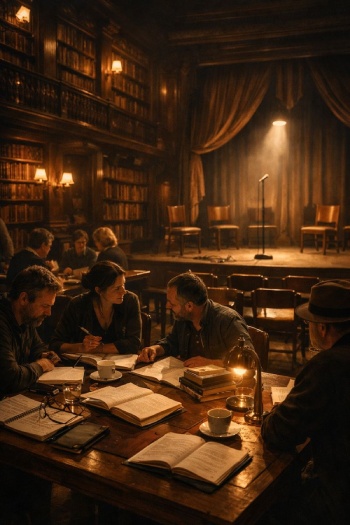
Beyond preservation, libraries have often served as active environments for theatrical creation. They provide access to source material, quiet space for writing, and institutional support that enables new work to emerge. This role is less visible but deeply influential.
Before examining contemporary examples, it is important to recognize that theatre has always depended on research, reading, and shared knowledge, all of which libraries are designed to support.
Playwriting and Research
Many plays begin not on stage but at a desk. Playwrights rely on historical records, literary works, and theoretical texts to develop their ideas. Libraries offer structured access to these resources, allowing writers to ground imagination in research.
This relationship shapes the content of theatre itself. Historical dramas, adaptations, and socially engaged plays often draw directly from archival materials. In this way, libraries influence not just how theatre is preserved, but what kinds of stories get told.
Libraries as Rehearsal and Performance Spaces
Especially at the community level, libraries have functioned as informal theatres. Reading rooms, auditoriums, and multipurpose spaces host readings, small performances, and workshops. These events blur the line between literary and theatrical culture.
Such uses reinforce the idea of libraries as living institutions rather than static storage facilities. When performance enters the library, storytelling returns to its communal roots, reminding audiences that texts are meant to be activated, not merely shelved.
Access and Democratization
Libraries lower barriers to participation. By offering free access to scripts, criticism, and educational resources, they allow theatre to extend beyond professional stages. Students, amateurs, and independent artists all benefit from this openness.
This accessibility supports diversity in theatrical voices. When resources are not limited to those with institutional backing, experimentation becomes possible. Libraries quietly shape theatre by making knowledge available to those who might otherwise be excluded.
Modern Intersections and Evolving Roles
Both theatres and libraries have been changing in respect of adapting to pressures of prints to the contemporary scene, changing their relationship. The advent of digital archives, program composites, and public expectation increases and changes the ways in which these two institutions relate. An understanding of theatre and libraries can be hacked by exploring common challenges: scarce funds, audience habit changes, and above all, the matter of relevancy in the digital world.
Digital Archives and Performance Records
Libraries increasingly preserve theatre through digital means. Recordings, scanned scripts, and online catalogs extend access beyond physical walls. This shift allows performances to reach audiences who may never attend a live show, while also raising questions about what is lost when theatre is mediated through screens.
For theatre practitioners, digital archives offer new tools for study and revival. Directors can research past productions with greater ease, while scholars gain broader access to materials that were once geographically limited.
Collaborative Programming
Many libraries now partner with theatre groups to host talks, staged readings, and educational programs. These collaborations frame theatre as part of a broader cultural conversation rather than a standalone art form.
Such programming reinforces the idea that storytelling crosses formats. A play discussion in a library context encourages audiences to engage critically, linking performance to literature, history, and social issues.
Public Engagement and Cultural Trust
Both theatres and libraries rely on public trust. They position themselves as spaces where ideas can be explored safely and openly. In an era of fragmented media and polarized discourse, this role has become more visible.
By working together, these institutions strengthen their credibility. Theatre brings immediacy and emotion, while libraries offer depth and context. Together, they support informed imagination rather than passive consumption.
Theatre, Libraries, and Education
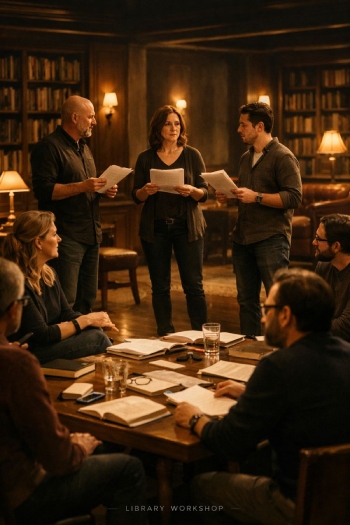
The performance and the library have always met in education. Schools, colleges, and community programs use both to develop critical thinking, empathy, and cultural literacy. It is useful to note that both institutions consider education as an active process rather than a simple instruction.
Learning Through Performance
Theatre teaches by doing. Students engage with texts physically and emotionally, testing ideas through action. Libraries support this process by providing the materials that make informed performance possible.
Scripts, criticism, and historical context deepen understanding, allowing performance to become a form of inquiry rather than imitation. The library’s role is quiet but essential in this learning loop.
Libraries as Learning Environments
Libraries support theatrical education by offering neutral, resource-rich spaces. Workshops, reading groups, and study sessions often take place there, especially when formal theatre facilities are unavailable.
This accessibility broadens participation. Learners who might not feel comfortable in traditional theatre settings can explore performance through library-based programs, reinforcing inclusion.
Critical Literacy and Interpretation
Both theatre and libraries teach interpretation. Theatre asks audiences to read meaning in action and dialogue, while libraries encourage close reading and comparison. Together, they help individuals develop the ability to analyze, question, and contextualize information.
This shared educational mission strengthens their partnership, especially in an era where critical literacy is increasingly necessary.
Enduring Differences That Sustain the Relationship
Even though libraries and theaters overlap, they differ in productive ways that balance rather than obstruct each other. One provides what the other cannot. Before outlining exactly what book emporiums and theaters share in a long-standing relationship, it makes sense to define and even extol these differences.
Time, Presence, and Permanence
Theatre values presence. Libraries value permanence. One prioritizes immediacy, the other continuity. Together, they allow culture to exist both now and later, in experience and in record.
This balance ensures that stories are not lost to time nor frozen beyond relevance.
Emotion and Reflection
Theatre engages emotion directly, often asking audiences to respond instinctively. Libraries encourage reflection, offering space to process and revisit ideas at one’s own pace.
The movement between these modes enriches understanding. A play may provoke, while a library provides the tools to think through that provocation.
Risk and Stability
Theatre thrives on risk. Libraries emphasize stability. New ideas can be tested on stage, while libraries provide the continuity that prevents cultural amnesia.
Their coexistence supports both innovation and responsibility within public culture.
Why This Relationship Still Matters
In a world increasingly driven by speed and digital consumption, the relationship between theatre and libraries offers a different model for cultural life. It values shared space, thoughtful engagement, and respect for both moment and memory.
Understanding this relationship helps explain why these institutions persist even under pressure. They meet fundamental human needs that technology alone cannot replace.
Both theatre and libraries treat imagination as something to be cultivated collectively. They resist privatization of stories, insisting instead on access, dialogue, and participation.
Stories That Outlast the Moment
Theatre and library relations form the substance of an evergreen practice rather than being just relics of an eventful past. Theatre breathes life into stories; books keep them stored. Both together serve to remind people that culture does not just happen in performance or while stored, but is to be carried forward under shared effort. Theatre and libraries, through their being in existence and in preservation, influence their respective societies, defining societies in remembrances of themselves, their hopes, and their understanding.